Stroke rehabilitation that considers the individual
Strokes affect us in different ways – and no one journey to recovery is the same. For some, it may take days or weeks to recover. For others, the journey is longer.
Whatever your situation, our carers have comprehensive training to help you to thrive. Through care assessments, Walfinch can provide professional insight into adapting your home and lifestyle to better fulfil your needs.
Work with our carers to set goals and, through small steps or big leaps, to make now your time to thrive.

It’s never too early to take control of your health
It’s never too early to start your rehabilitation journey. Our carers are prepared to support you from day one, as well as provide emotional support to your family and loved ones. As experts in transitional care, we can help get you out of the hospital and back home – depending on your goals, wants and condition.
From there, we can start mapping out your plan to thrive. It may start small with supported eating, grooming, bathing, toileting and dressing – or progress with mobility support, such as transferring from chair to bed, bed to chair, wheelchair use, or walking. Depending on your situation, you may also want us to work with you on communication and language therapy, social interaction and problem solving.
All of these can be practised and developed with just a small about of focused, regular activity – taking the pressure off your loved ones and family, and helping you take control of your health, on your own terms.
Your roadmap to thrive: stroke rehabilitation
Whether big leaps or small steps, below is your roadmap to recovery – which can be adapted to fit you.
Step 1: Transitional care
This gets you out the hospital and back home, in your comfortable environment. It provides you and your family with a bit more normality.
Step 2: Activity promotion
Through our specialist Walfinch care, we promote 10 minutes of activity per one hour visit. We can adapt this to truly benefit you by writing into your care plan activity to better improve your movement.
Step 3: Emotional support
Once the shock has passed, we’ve found people start to experience emotional difficulty. Having the daily physical and emotional support from our carers makes a world of difference.
Step 4: Ongoing assessment and adaptation
Lorem ipsum dolor sit amet, consectetur adipiscing elit. Vestibulum non nisi commodo, commodo ex vel, fringilla erat. Quisque eu volutpat nunc. Nulla tristique tellus leo, quis volutpat turpis tristique sit amet. Fusce in finibus.
Everyone’s journey is different, and we all thrive in different ways. It’s our job to help you navigate these uncertain times – and continue living life to the fullest.

Key components of stroke rehabilitation
We’ve found it most beneficial to focus on two key areas for your recovery:
Physical Recovery
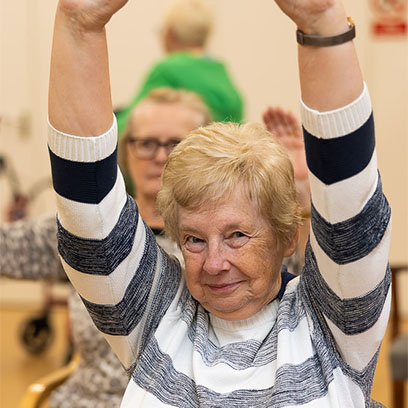
We can support you by encouraging activity and assisting with mobility on a regular basis. If you wanted to take things a step further, we could take you to a free, local Walfinch Thrive Club – an accessible, easy-to-follow seated exercise class designed and hosted by Walfinch. If you’re not quite ready for that, we have a suite of online resources and follow-along videos to support your physical recovery – allowing you to thrive in the comfort of your own home.
Cognitive and Emotional Recovery
The truth is, a stroke can have a huge impact on your life – and you don’t have to navigate these alone. Our carers are trained to support clients cognitively and emotionally. We can even match you with carers that you’d best get along with, to better support you along the road to recovery.
The initial assessment was sensitively handled with a natural human, one-to-one approach and that promise has been followed through week to week, day to day. Their staff are very kind, full of sensitive personality and have become more than carers – always going above and beyond… I would recommend Walfinch confidently to anyone looking for bespoke, respectful and authentic care. What could be seen as a negative stage of life, is in Walfinch’s hands turned into a real positive.
MF (Client), Walfinch Reigate and Horsham
Start thriving today through quality care
It’s never too early to kickstart your thriving journey. Use your care to take control back over your life and your health – and we can navigate these uncertain times together.
We don’t see care as the end – it’s just the next chapter. Some clients have found that just four hours of care a week has provided transformative results. It’s never been easier to live better for longer. Through various techniques and approaches to care, tailored around your lifestyle and goals, you can make now your time to thrive.

Your questions, answered by us
Expert answers to your frequently asked questions about stroke rehabilitation.